
Frequently Asked Questions
Definitions ∙ Curriculum ∙ Instruction ∙ Materials ∙ Pace ∙ Evaluation ∙ Handouts
What is “expansive learning”?
When Thomas Jefferson challenged Meriwether Lewis and William Clark to “learn all you can” during their epic 1803-1806 transcontinental journey, he wasn’t kidding. That phrase concluded a long list of questions to be answered about the peoples and places the Corps of Discovery would encounter. (Incidentally, in addition to the captains, the Corps was an exceedingly diverse group in terms of age, ethnicity, and gender.) In this way exploration draws from all content areas—science, history, mathematics, literature, physical education, and the humanities, so serves as a powerful theme for interdisciplinary “expansive learning.”
The chief asset for exemplars of lifelong learning like Jefferson, Eleanor of Aquitaine, Marco Polo, Ibn Battuta, Hildegard of Bingen, and countless others is curiosity. Were such people explorers, writers, diplomats, linguists, or something else? They sought to understand the world through all these roles, and as such are ideal subjects of study for young and old alike. So the Journeys approach is all about unleashing student curiosity and giving them authority to explore through readings, experiments, observations, and projects that are then shared in person and online with their peers and others.
What instructional resources are available to support this curriculum?
The basic Journeys resources are (1) the core “Travelogue” readings, (2) the associated “Sourcebooks” of correlated subject matter lessons, and (3) the instructional “Guidebook.” The Travelogue relates the actual journey account in an illustrated four-page series including a Study Guide, Travelogue Reading (2 pages), and Resource page. The Sourcebook that accompanies most Journey binder Travelogues contains correlated social studies, language arts, science, and arts lessons. The Guidebook is for teachers and facilitators.
An important consideration is that the term “curriculum” comes from the Latin currere, which means “to run a course.” It does not imply covering the most distance in the shortest time, but is all about active participation. Student-centered inquiry is a powerful motivator, while also conditioned by age-appropriate content and skill learning objectives. Journeys of Discovery lessons are based on relatively brief original source readings that are true accounts of inquiry that acquaint learners with humanity’s rich cultural heritage and world geography. Moreover, they invite timeless connections to opportunities and challenges in contemporary life.
So the Journeys of Discovery approach does not consider the core “Travelogue” readings or supplemental resources to be “the curriculum.” Rather, the Journeys curriculum is what students regularly produce themselves from their interactions with readings and resources that is to be (1) written, (2) illustrated, and (3) presented. Their ongoing creations form a compelling account of new understandings while “running the course.” We write down ideas students toss out and brainstorm as we read through the day’s journal entry. We often allow time to discuss the questions they raise, and encourage higher levels of thought (see Leading Questions of Discovery and Conceptual Themes chart below) and sometimes we just write them down so they have a menu of choices to select one later as the subject of their illustrated journal and presentation.
What does a day’s Journeys lesson look like in practice?
A Journeys Travelogue reading is relatively short and typically consists of several paragraphs. At first glance a teacher, parent, or instructional guide might reasonably think, “We could read this out loud in ten minutes, so then what’s left to do?” The answer is that as we blur the line between student and teacher we are all more fully empowered to become “learners” through the process of informed inquiry. Whether on a wall in our Journeys classes over the years or in a homeschool setting, we start by distributing to everyone and putting up on the wall posters with essential information that will guide all our endeavors (see below, and in the Instructor’s Guidebook): “Leading Questions of Discovery and Conceptual Themes,” “A World of Illustrated Journalizing Possibilities,” Quality Writing Attributes,” and “The Architecture of Moral Education.”
So when we’ve had groups of students for at least a 90-minute bloc (and I’ve done this with elementary students from grade five to seniors in high school), here’s how I’ve arranged the time:
1. Opening and greeting: about 5 minutes
When we first start out on a Journey I always have students color the expedition map and group portrait. An educational truism—from elementary to high school, kids still love to color!
2. Review of either the previous or current reading Study Guide: about 10 minutes
I always start by “orienteering”—asking/reminding them where we are geographically and chronologically on the Journey.
3. Travelogue Reading: about 25-30 minutes
We typically read each Travelogue reading out loud, sometimes I’ll read a paragraph, but I mostly have students read. EVERY student must be prepared to volunteer a topic of interest or have a question about something encountered in the paragraph, sidebar annotation, or related idea. This takes mental exertion work—so welcome to life! We don’t spend a lot of time talking about these, that can come later. For now, the important thing is to generate a list of 6-10 topics that they can pursue for the their next illustrated journal entry. Of course the teacher is a “learner” as well, so open to contributing a topic or two related to something deemed significant to know or find out about.
4. Travelogue Reading Ideas Review: about 5 minutes
I go down the list of possible topics just listed, asking specific students what they think might be worth exploring further.
5. Presentations of Student Illustrated Journals: 20-30 minutes
This is an informative, fun-filled component of the Journeys experience that affirms research and critical thinking, builds individual communication skills, and promotes cooperative group work. In a class of 25-30+ students, there is only enough time for about a half-dozen students to present (see “A World of Illustrated Journaling Presentations” below). Of course the ones who don’t have time to present have good reason to be disappointed since they have invested valuable exploring time. But this is a “nice problem” to have since boredom is not an option. I regularly keep an up to date record of students who have presented to ensure equity.
6. Correlated Content Area Reading: variable time
This is time for study of the additional resources that follow the Travelogue readings which may be the Resource Page that immediately follows each Travelogue Reading, or any of the correlated social studies, language arts, science, or other instructional material.
7. Independent Research, Writing, Illustrating, and Project-Making: variable
No matter how compelling a story to read or how profound we might think a lecture, power-point, or digital resource might be, student surveys consistently identify their most popular learning endeavor: MAKING THINGS! So the educational imperative is to let them make a power-point, oral presentation, film, experiment, work of art, culinary masterpiece, etc.
Here’s a paragraph that came recently from student who had just read Reading 1.1 from the Lewis & Clark Journey of Discovery:
I’m impressed by President Jefferson’s use of English though it took some adjusting for me to read at first. They certainly wrote and probably spoke different in those days. A couple things jumped out at me. First, the brief genealogy information was interesting and led me to look into my own background. My mother did some work on that a while ago but I never really thought much about it until now. I also thought Jefferson’s descriptions of his mentors was interesting.
I found out that my great-grandfather took part in the Klondike Gold Rush, and we even have records of my grandmother’s brother, who died when he was very young. Even though we live here in the city, there is a building downtown that is run by the National Park Service that tells all about the Gold Rush so I found some information online and hope to visit there sometime soon. I didn’t even know there were National Park locations in cities, so now I’m wondering how to get a job like that.
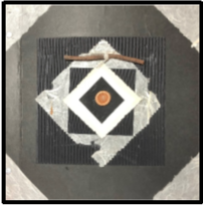
My Journal Cover
I also thought it was interesting in this reading that Jefferson told about a math teacher that he really liked. Here is what he said: “It was my great good fortune, and what probably fixed the destinies of my life, that Dr. William Small of Scotland was then professor of Mathematics, a man profound in most of the useful branches of science, with a happy talent of communication.” I think it would have been
fun to know this person and find out what Jefferson meant. I also learned a new Latin phrase that I’d like to use for some of my friends: Amici Omnium horarum, “a friend of all hours.” I would like to put that on my new journal cover which I made out of cardboard, tissue paper, and an old button!
This entry, by the way, reminds me that whether working with elementary or secondary age students, I typically asked for only a paragraph or two per Travelogue reading entry. One night I received a call from a concerned parent who thought her middle school son’s assignment was excessive. He had been working with a friend on play script for over two hours that they hoped to perform for the class in readers theatre format the next day. When I explained that the assignment was for just one paragraph, she paused for a moment, and then said, “You mean they’re doing this because they want to?” Those are nice problems for a teacher to have.
What special supplies are needed?
When I started teaching many years ago I got high marks from our building principal because my class was so quiet and neat. Well forget that. It wasn’t long before I found out that the most successful teachers inhabited very active, often noisy though orderly places. Students learned from the start the necessity of hard work and getting along with others, and the value of their own creations. No need for elaborate furnishings and expensive equipment. Certainly having access to laptops and digital whiteboards is nice, but neither Eleanor of Aquitaine or Marco Polo had those and they were champions of expansive learning. The principal asset is curiosity, which is innate. Children come to preschool and kindergarten wanting to know why the sky is blue and flowers bloom. Too often the externalities of education press ponderous lists of facts and skills upon them, and in a few years they become less inclined to inquiry.
So the most powerful asset for effective learning—an inquiring mind, requires no special materials per se, but can be wonderfully enhanced by providing basic supplies for hands-on learning like regular white paper, colored pencils, heavier tagboard, rulers for HO scale model making (1 inch = 8 feet), ingredients for salt modeling clay (flour, salt, alum), scissors, etc. National Geographic print or digital resources and back issues of travel magazines are helpful. There are numerous affordable activity-based science kits that can be easily correlated to Journeys units, and having magnifying glasses and microscope along with other basic lab equipment can provide a host of enriching science experiments. In this way high school students who gave up asking can actually find out for themselves why skies are blue and flowers bloom. Many never learned. And now we need them more than ever to head out into a world that very much needs their minds to deal with energy shortages, improve stewardship and use of natural resources, and promote good health.
What is the pace of a Journeys course?
We have found that two to three Journeys Travelogue readings is sufficient for a full week of learning, but of course pace depends to some extent on the circumstances for study and investigation. A Journey series of 45 readings, therefore, might well cover several months of instructional time. While period readings and other printed resources provide the basis of study, they are not the ends of learning in themselves. Rather, they provide the basis of connections to real worlds past and present, as well as the imagined future which provide the prompts for the illustrated student journals.
In most traditional school settings, daily schedules are arranged around morning and afternoon “periods” that can vary from a half-hour at the elementary level to ninety-minute interdisciplinary “blocks” for middle and high schoolers. In a homeschool setting with the possibilities of cross-age grouping, one to two hours of instruction may be more than sufficient with options as age-appropriate for project time. We’ve worked with kindergarten teachers who simply read a selected sentence or two, while secondary students generally read the entire account either out loud or to themselves. Journeys is an interdisciplinary approach that seeks through Travelogue readings to show natural connections among the disciplines—how the social studies are related to the language arts, how science is related to mathematics, and how all are related to the humanities. While not a basal mathematics curriculum, Journeys lessons provide numerous math problem-solving activities.
How are Journeys assignments graded?
The wide variety of evaluation methods generally conform to qualitative and quantitative approaches. Effective qualitative evaluations involve judgments about performance that are based on criteria clearly understood by students. These can be written as a narrative summary about a student’s progress, or marked in a rubric checklist that shows descriptors of achievement levels for subjects (social studies, language arts, science, etc.) or interdisciplinary skills like research and concept formation. Quantitative measures include responses to true/false, multiple choice, and other questions that can be reported in percentages that are often converted to traditional letter grades. The Journeys curriculum does not supply unit tests though it is certainly possible for anyone to create those. The following rubric, however, has been widely utilized to evaluate the core Journeys task of student journaling.
Suggested Journeys Rubric to Evaluate Student Journaling
(Levels within each category indicate Beginning, Developing, and Extending levels of proficiency.)
Research—
Beginning: Standard reference works and text materials used as directed.
Developing: A variety of printed and electronic resources consulted to gain new knowledge.
Extending: A wide range of resources, experts, and primary source materials used independently.
Concept—
Beginning: Expresses an ideas in complete sentences.
Developing: Paragraphs develop main ideas; further details needed.
Extending: Content remains focused with effective paragraph transitions.
Style—
Beginning: Vocabulary and sentences need variety and to reflect personal interest.
Developing: Some new terms and expressions evident; ideas reflect personal involvement.
Extending: Original expressions and vivid descriptive language are unique to the author.
Conventions—
Beginning: Capitalization, punctuation, and spelling often needs correction.
Developing: Occasional misspellings and grammatical errors interfere with expression.
Extending: Text flows without distraction from spelling and grammatical errors.
Illustrations—
Beginning: Illustrations are attempted but representations are disorganized or unclear.
Developing: Representation of learnings and observations are clearly and variously shown.
Extending: A variety of relevant illustrations are meaningfully presented.
Delivery—
Beginning: Voice projection and eye contact are needed to effectively communicate.
Developing: Projection and presence sufficient to inform listeners.
Extending: Effectively appeals to audience through voice, presence, and enthusiasm.
Revision—
Beginning: Proofreading and suggestions to improve not evident in final drafts.
Developing: Self and peer evaluation and suggestions incorporated into final drafts.
Extending: Contributes to self and peer evaluation and applies relevant comments.
What do comparative test results show about the effectiveness of interdisciplinary, project-based learning like Journeys?
In spite of American public schools’ preoccupation for the past twenty years with high-stakes, quantitative measures of student achievement, numerous peer-reviewed studies indicate that students who experience thematic, interdisciplinary learning do as well or better than in single-subject classroom. Educators in any setting are wise to also consider affective influences on learning like the joy of learning to promote enthusiasm and hard work. The wide range of relevant studies on these topics include Linda Darling-Hammond (“Assessment for Learning Around the World,” 2008), Eliot Eisner (The Enlightened Eye: Qualitative Inquiry and the Enhancement of Educational Practice, 2017), and Nel Noddings (Education and Democracy in the 21st Century, 2013). In addition, there are many teachers around the world who practice expansive learning. A notable American example is Shady Hill School in Cambridge, Massachusetts.
In the 1990s when we launched the Journeys curriculum project, I worked closely with teachers and students in fourteen elementary and middle school classes from four separate Northwest public school districts. Each class followed a Journeys curriculum Travelogue for nine months, and participated in statewide norm-referenced standardized testing. Results were compared with their counterparts in fourteen other classes from the same districts using conventional curriculum and instructional approaches. Eleven of the fourteen Journeys classes posted higher gains, three showed no statistical difference, and in no instance did Journeys of Discovery learners achieve at a lower level in any subject category.
But one evaluative factor stands out more in my mind than any statistic: Journeys students recurrently experienced the joy of expansive learning by reading, writing, and building to the extent that we frequently had to order them out to recess!
How many Journeys of Discovery Travelogues are available?
At the present time we have the following that are available through the website, many of which also have associated Sourcebooks:
Eleanor of Aquitaine and the Crusade of the Kings: A Medieval Journey of Discovery
The Travels of Marco Polo and Ibn Battuta: Asian and African Journeys of Discovery
The Exploits and Columbus and the Conquistadors: New World Journeys of Discovery
The Expeditions of Lewis & Clark and Zebulon Pike: North American Journeys of Discovery
David Thompson and Fur Trade Voyageurs: Northwest Frontier Journeys of Discovery
The Sojourns of Ancient Israel: An Old Testament Journey of Discovery (I)
The number of possible Journeys of Discovery, of course, is vast given the scope of exploration near and far since the dawn of time. The process of gathering accessible original sources and formatting them with age-appropriate annotations, illustrations, study guides, and other instructional resources is very time consuming. At this time we do have these others at various stages of development:
The Annals of Herodotus, Alexander, and Caesar: Classical World Journeys of Discovery
Europe’s Grand Tour and the Behaim Family: An Early Modern Journey of Discovery
Elizabeth I and the Wayfarings of Drake & Raleigh: Seafaring Journeys of Discovery
The Voyages of Captain Cook and Alexander Mackenzie: Pacific Journeys of Discovery
Chronicles of the Kings: An Old Testament Journey of Discovery (II)
What if I do something “wrong”?
Then welcome to club of explorers and lifelong learners! Any questions students pose that go unanswered, any readings that suggest more mystery than resolution, and experiments that don’t validate a hypothesis all represent opportunities to more fully understand one’s self, others, and the world around us. To be sure, great explorers through the ages underwent thorough preparation before embarking on their adventures. But a zeal to learn is the foremost qualification for successful expeditions whether real or imagined.
Charts, Handouts, and Additional Resources
Leading Questions of Discovery and Conceptual Themes
A World of Illustrated Journaling Presentations
The Architecture of Moral Education