
Student Work Samples
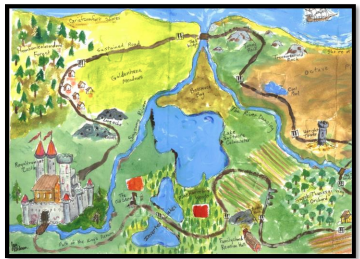
The following examples of illustrated journal selections feature entries from both elementary and secondary students. Students typically contribute two to three paragraphs each week based on a topic of personal interest identified in a Journeys Travelogue reading. These topics range widely and do not preclude a subject assigned by the instructor. The same topic may also be explored in greater depth in several paragraphs. Drawings, charts, paintings, models and other methods to illustrate paragraphs can be made with basic computer graphics programs or from readily available materials—colored paper, cardboard, straws, glue, and the like.
Educational leader John Gardner has wisely observed, “We all too often are giving young people cut flowers when we should be teaching them to grow their own plants.” In other words, let them fine creative ways to “construct” their own understandings. Students are expected to proofread journal submissions either themselves or through peer review. The examples here are from sixth grade students and above and presented with minor edits for fluency.
“Finding Directions”—The Journey of Lewis and Clark (Chapter 2)
Thomas Jefferson seems to have been interested in just about everything so maybe that is why he was successful in so many things. To him education took place at school and home and outside. Seems like learning from both books and nature where his great loves. He kept records of daily temperature and wrote a diary for most all his life. I’m not sure he or Lewis and Clark thought much about ever being famous. They just curious and did what they thought was important. If you look at all of history we’re not really all that far from their time. But now we have electronic ways to keep track of time and locations. To find their direction during the expedition, the explorers used a compass which is a Chinese invention maybe 2,000 years old! They probably first used it to tell fortunes but later it became a valuable tool to find directions because the earth is like a giant magnet and the metal needle lines up parallel with the magnetic field it creates. I saw how this worked by putting a magnet under a piece of paper and dropping some tiny iron filings on top. Sure enough, they made the same kind of rounded shape! Travelers have used compasses for hundreds of years and we take one with us whenever we hike in the mountains. You just never know when a battery might die!
“Lipizzaner Horses”—Eleanor of Aquitaine and the Crusade of the Kings (Chapter 4)
The movie “Crimson Tide” has nothing to do with horses. It is about a submarine that receives orders to launch their missiles. In the conflict on board that happens afterward, the captain asks an officer if he has ever heard of the Lipizzaner stallions. He then says that they are the most highly trained horses in the world and are all white. Having read now about the breed I decided to find out more about them. They were originally from the border area between Italy and Slovenia where a royal horse farm was founded in 1580 at a place called Lipizza by a member of the Austrian royal family. It is true that Spanish horses were also brought to the farm for breeding, but in later years Arabians were also used for this purpose. During World War II the Germans took most of them away but some were returned to Lipizza and others were taken to the Spanish Riding Academy in Vienna, Austria, where you can see these beautiful creatures today.
“The Silk Road”—The Travels of Marco Polo (Chapter 3)
The main purpose of the Silk Road was for a trade route to move goods mostly from the East to the West. Silk may have started out as the major trade item, but fairly soon it became one of many trade goods going along the many routes. This is because it was not actually just a single road for the entire distance of five thousand miles. The Silk Road was a network of several main roads and small ones used by traders and travelers. Today many places along it are popular tourist destinations. If I was a tour guide I would like to begin in Antioch, Turkey, but if you were bringing things out to sell from Asia on a caravan that would be where the journey ends. Antioch is an ancient city and today there is lots of conflict in that part of the world so that may interfere with any real tour plans. I saw some pictures of Antioch online and some look very mysterious with all the ruins of ancient buildings.
“Omai and Homesickness”—The Voyages of Captain Cook (Chapter 1)
I’ve been wondering about Omai who Captain Cook took to England which was so far from his home in the South Pacific. I like going to a new place and meeting new people and learning new things. He must have also liked doing these things or probably would never had gone along. But I think it is also natural after a while to miss your family and friends and old home. These days people can travel around the world and communicate much easier than in Captain Cook’s time so the world seems to be getting smaller. You can fly to China in about ten hours but people like Omai managed to cross vast oceans in long voyages and face many dangers. We read how Omai missed his people and home, and that could happen to any of us.
Alhambra Play Script, Scene 1—The Exploits of Columbus and the Conquistadors (Chapter 1)
Alberta: Oh, this is such a beautiful place. (She takes a picture.)
Beth: It really is, and looks so ancient.
Montgomery: If I owned this I’d have it torn down and put something new up.
Nancy: You can’t tear this down, the whole building is a work of art.
Alanna: I’m not so sure (turning to Montgomery); maybe he’s right and more people would come here if it were a mall.
Montgomery: Now there’s an idea! Yes, turn the whole place into a nicest mall you’d see anywhere.
Beth: How can you say that! These mosaics are beautiful, priceless, and delicate. Don’t even think about it!
Alberta: And just think about how hard it must have been for the Moors to make these mosaics, and it’s an important part of Arab and European history.
Montgomery (to Alanna): How about we do something to make them all think this place is haunted?
“Satellite Exploration”—The Journey of Lewis and Clark (Chapter 3)
Squirrels swimming across rivers, passenger pigeons, a huge tusk, and tooth from a wooly mammoth! These are just a few of the hundreds and hundreds of “discoveries” the Corps of Discovery wrote about and drew for President Jefferson back in Washington, D.C. The expedition learned so much. Reading the resource page about “Remote Sensing” sent me on my own little online journey to learn more about satellite imagery. I learned that the first satellite pictures of the earth were taken as early as 1959. NASA and private companies do satellite imaging now. One called Quickbird now provides high resolution photographs allowing objects as small as 60 cm to be seen from space! The scanning sensors of these satellites are called “radiometers” and somehow an electronic circuit sensitive to a small level of energy measures as it scans across the earth (or a planet or moon). What would Lewis or Clark think if they could orbit above the earth today and explore the Missouri River and Rocky Mountains that way?!
“The Great Wall and Gobi”—The Travels of Marco Polo (Chapter 4)
The Great Wall of China is over 600 miles long so is truly a Wonder of the World. It probably looked different in Marco’s time because it was not built as one continuous wall, but several ones constructed and repaired by different rulers over many centuries. It did protect the Chinese and Silk Road travelers and goes south of the Gobi Desert, which actually can be a very cold place! But eventually the Mongols came down from the north anyway so it makes you wonder just effective big walls really are. I’ve been interested in that place ever since reading a book we have at home called All About Dinosaurs which tells about some of the famous dino hunting expeditions over the last hundred years or so. I remember that some fossil hunters, called paleontologists, have made important discoveries in the Gobi Desert including the velociraptor made famous in the Jurassic Park movies. Its main body was probably covered in feathers and was only about the size of a large turkey. But it had a long tail was a ferocious fighter. More fossils from different species of dinosaurs have been found in the Gobi Desert than just about anywhere on earth. I’d like to go there someday and am glad that the only velociraptors there today are frozen in the rocks.
“What’s in a Name?”—The Voyages of Captain Cook (Chapter 2)
It is interesting to see how Captain Cook spelled out native words using their sound like with Woahoo. I think he is talking about the island of Oahu. I’ve been looking at maps of the Hawaiian Islands, Fiji, and Tahiti and trying to figure out which islands James Cook is naming according to how he heard the words from the people living in those places. They had their own languages and probably did not use an alphabet system. Maybe some of their sounds could not be expressed by alphabets like ours. I have a friend who came here from the Middle East and she writes some sounds that we do not have in English. Language is a tool for communication and seeing the differences and similarities is interesting to me.
“She Never Complained”—The Journey of Lewis and Clark (Chapter 5)
I think one of the most interesting parts of the journey took place during the winter of 1804-05 when the Corps built Fort Mandan on the Missouri River. In the late fall they first saw the Northern Lights. I this a couple years ago for the first time and was also moved like the members of the expedition so long ago. A few day after this beautiful sight, the Corps me the now famous Sacajawea. They hired her husband, Charbonneau, to be their interpreter. She had been captured a few years earlier by the Mandans from her native people, the Shoshone, and then purchases by a French Canadian fur trapper to be his wife. Little did anyone realize Sacajawea’s true value until on the journey. Lewis wrote that she never complained, no matter what. Many of the tribes they would meet accepted them because of her. It is thought that Sacajawea was born around 1790 which would make her only about 14 years old at the time she joined the expedition.
“Strong, Shiny, and Colorful”—The Travels of Marco Polo (Chapter 4)
Sericulture is the word that describes all parts of silk production from raising the silkworms to spinning the silk thread and weaving it into beautiful cloth and rugs. This has been an important industry in China for thousands of years and silk was a valuable cargo carried by traders on the Silk Road between Asia and Europe. The creation of silk begins when a silkworm spins a thin fiber all around its body, and begins to change into its larval form. But before that happens on silk farms, the cocoons are placed in bowls of boiling water to kill the larva and loosen the fibers. A thin fiber is pulled from each one and four or more are twisted together to make a thread that is strong enough to weave. Because silk thread is strong, shiny, and could be dyed into bright colors, it was highly valued as a trade item. Chinese rulers did not permit the export of silkworms or sharing information about silk manufacture, but by 300 AD silkworm eggs has been smuggled to Japan and India. After several hundred more years silk production reached Italy. My mother has a red and yellow silk scarf that was given to her by my aunt who brought it back from Europe. It is very beautiful so I can see why it was such a popular item on the Silk Road.
“Camels B and D”—The Travels of Ibn Battuta (Chapter 9)
The Dromedary camel has one hump and lives in the deserts of North Africa and the Middle East which get very hot. The Bactrian camel has two humps and lives in the deserts and steppes of Asia where temperatures can vary from very hot to very cold. Bactrian camels can survive in temperatures ranging from 40 degrees below zero to 120 degrees Fahrenheit. It grows thick, shaggy fur in winter and sheds it in summer. The Dromedary camel, which is faster, has a shorter coat and cannot live in places with extremely cold temperatures. Bactrian camels have a mane on their shoulders, another on their chin and neck. Both types of camels store fat in their humps which allows them to go 3-4 days without food and water, and makes for great desert travel. The Bactrian camel can drink up to 32 gallons of water at a time! Busy eyebrows and long eyelashes protect their eyes from sandstorms. They are both grazers with tough mouths who will eat about anything including thorny desert plants. I also found out a great way to keep their names straight—the letter B for Bactrian has two humps, and the letter D for Dromedary has one.
“Rimrock Lake”—The Journey of Zebulon Pike (Chapter 7)
I took a trip with my family to Rimrock Lake during vacation and saw several species of birds including a blue Stellar’s jay, Western tanager, and grosbeak. There were also what looked like finches and a bird that sounded like a clicking noise rushing about the lower bushes. Maybe it was a junco. The grosbeak stayed on top of a pine tree long enough for me to see it with binoculars. It was yellow with black wings and some reddish orange on the breast. Several Western tanagers flew around and they hopped around on the ground and the lower part of the trees long past sunset. I also saw a chipmunk that was chased by our beagle. And a mouse ran out from under my chair as I was reading about Zebulon Pike!
“Spice for Life”—The Travels of Marco Polo (Chapter 6)
If you like to eat then try having a meal with no salt or pepper or sugar. The main ingredients may be the largest amount of any meal, but even very small amounts of spices make it taste so much better. From ancient times the people of Europe traded and paid high prices for spices from Asia and came to especially like cinnamon, cloves, and ginger. Various kinds of pepper (black, white, and green) and turmeric livened up many dishes and could also help preserve meat back when there was no refrigeration. Most of the spices were native to the tropical areas of southern Asia. The demand in Europe for spices was an important reason that discoverers like Columbus and Magellan wanted to sail around the world. This eventually led to the great trading empires of France, Holland, and Great Britain, and to all kinds of wonderful ingredients you can find at the store.
“Night Skies”—The Journey of Zebulon Pike (Chapter 8)
The Pawnee Indians worshipped the Pleiades star cluster and made shrines to the Morning Star and Evening Star, both of which are Venus. They sometimes laid out their villages to match the positions of bright stars. The pole star (Polaris) was considered to be a chief that protected the rest of the stars and the people. Some astronomers think that the supernova explosion witnessed by some Indian tribes was the same one recorded by Chinese astronomers around July 4, 1054 AD. I was hoping to view this place using the Starry Night program. Unfortunately the supernova is not there. I was able to view the sky in drawings, but the computer program I explored did not have the supernova on it. Bummer. But I could zoom in on the Crab Nebula, which is what a supernova looks like long after it explodes. This also created the question whether the Star of Bethlehem was a supernova. So I did a search for ones that might have happened 2,000 years ago and found a nice summary of astronomical events during that time and how some might have been seen by the Magi.
“Strong and Straight”—Eleanor of Aquitaine and the Crusade of the Kings (Chapter 7)
The cedars of Lebanon were prized above all other trees in ancient times in the Middle East and beyond. Lebanon cedars were used to build temples and palaces because they were strong and straight, and also smelled good. King Solomon important cedars from Lebanon for the great temple in Jerusalem. There are few stands of these trees today due to the great demand for them over the centuries. The trees were especially threatened in the early 20th century when they were logged for railroad ties and for fuel. This clearing of the old forests then led to other problems. Air and water quality decreased in the mountains where these tall trees once stood so thick that sunlight hardly reached the ground. Erosion of the slopes into streams and rivers led to higher levels of salt in the soil downriver that caused lower crop production. Maybe there are lessons in what happened to the cedars of Lebanon a hundred years ago that we should be thinking about today.
“To Do Our Part”—The Travels of Ibn Battuta (Chapter 8)
Ibn often mentions some of the wonderful creatures that he saw on his travels through Africa. Today we often read about how many thousands of animal and plant species are threatened because of climate change and cities taking over natural areas. Scientists say it is happening at such a pace that we all need to do our part to find a solution so people and nature can live together. We need a balance so the world can remain a beautiful place. When we destroy plants and animals to extinction, we not only upset the ecosystem in ways that can harm our health, but we also lose something wonderful that can never be replaced. This seems to be happening in many places on Earth including around here where some of our fish and bird species are disappearing. Both endangered plants and endangered animals need to be protected by all citizens on the planet.
“St. Francis and Service”—The Journey of Zebulon Pike (Chapter 9)
Pike arrived in Albuquerque where he met the much loved Franciscan Father Ambroiso Guerra. The Franciscans were missionaries who were inspired by St. Francis of Assisi’s example of service to others. He lived in the 1200s in Italy and devoted his life to taking care of poor people and animals. Statues and paintings of St. Francis often show him holding a bird. In New Mexico Pike saw numerous canals which the people used to irrigate their crops which reminded Pike what he had read about the canals of Egypt. Unfortunately Pike’s own papers, maps, and other records were kept by Spanish officials who thought he might be a spy, but more likely he had just gotten lost. So when he returned home he had to rewrite everything as best he could from memory!
“Team Leaders”—Eleanor of Aquitaine and the Crusade of the Kings (Chapter 7)
King Richard the Lionheart was a brave leader, loyal friend, and a fierce competitor. All the armies on his side were glad to see him come. The same can be said of successful team sports players like team captains and certain coaches. They inspire confidence and loyalty in their teammates because they are dedicated to the sport and work hard to do their best and help everyone succeed. Players like Shaquille O’Neil and Tom Brady are like that. The play their best and inspire their teams to victory time and again. Doing your best may not always result in a winning season, but experiences failures of one kind or another. The important thing is to learn from our mistakes and keep going.
“Time to Listen”—The Expedition of Lewis and Clark (Chapter 6)
“All things are connected.” These words were spoken in the 1800s by Chief Seattle about why it is important or everyone to care about the land. When the first European explorers traveled by ship along the Pacific Coast they found that the Native Peoples consider the land sacred and belonging to everyone like air and water. They wanted the newcomers to also take of the environment and taught their own children to do the same. When settlers came to live there they made promises to the Indians to protect the rivers and land but now in many places it is polluted. Where once you could safely drink isn’t clean anymore and this may be causing people today to be unhealthy. I think it’s time we should listen to what Chief Seattle said a long time ago and take better care of our land.